UK Clean Power Announcement: What It Means for Multi-Site Businesses
58% of UK clean energy projects now have firm grid connection offers. Here is what it means for multi-site businesses, and why behind-the-meter generation does not require a queue position.
Behind-the-meter energy is increasingly the practical choice for UK multi-site businesses that cannot afford to wait for the national grid to catch up. NESO has confirmed that 58% of the clean energy projects in its 2030 pipeline have now received firm grid connection offers, covering around 37GW of capacity. That is a meaningful milestone for the UK’s Clean Power 2030 programme. Reuters Solar Power Portal NESO
For commercial and industrial operators, the headline figure is encouraging. The detail behind it is where the real planning question sits.
What a firm connection offer means
A firm connection offer gives a project a defined place in the connection process and sets out the expected connection date and related network requirements. It does not, by itself, mean all of the wider network upgrades needed to support that project are already built. Ofgem Reuters
Many of the projects in the 37GW pipeline still depend on enabling works such as substation reinforcement, new transmission circuits, or distribution upgrades. Those works follow separate planning, funding, and delivery processes, which means the connection offer and the associated infrastructure work may move on different timelines. Ofgem
For a business planning energy costs over the next five to ten years, that timing gap matters.
The commercial opportunity now
Wholesale electricity prices remain volatile, which keeps cost certainty high on the agenda for commercial energy buyers. Ofgem Businesses that want greater control over costs do not need to wait for grid-connected renewable capacity to be delivered before acting.
For sustainability teams, the same applies to Scope 2 reduction. A grid connection timeline measured in years is not the only route to decarbonisation.
Behind-the-meter does not depend on the queue
The grid connection queue applies to grid-connected generation. It does not apply in the same way to generation that is used on-site and stays within the site boundary. Ofgem
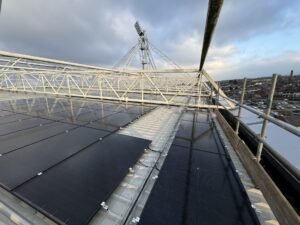
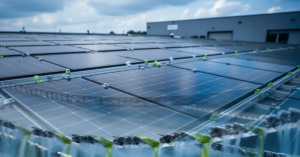
Behind-the-meter systems such as Solar PV and battery storage can reduce grid consumption directly. They do not rely on waiting for a national connection queue to unlock value at site level. Under a zero-capex PPA structure, the business avoids upfront capital spend while paying for energy through a long-term contract.
Planning and consenting for site-level generation can often move faster than grid-scale infrastructure, although exact timelines will depend on the site and system design.
What this changes
The 58% figure is an important signal that the UK’s clean power pipeline is moving forward. Reuters For multi-site businesses, the more practical question is what can be deployed now while the wider grid continues to catch up.
Behind-the-meter generation can provide price visibility and measurable Scope 2 progress on a timeline the business can control. In many estates, that strategy sits alongside the national transition rather than waiting for it.
Saber’s position
Saber structures behind-the-meter blended systems for commercial and industrial sites across the UK, funded on a zero-capex basis through long-term PPAs. The NESO announcement is a useful indicator of where the national grid is heading. NESO
A site-level feasibility assessment can show what behind-the-meter generation could deliver for your estate today, independent of any grid connection timeline.
It starts with twelve months of half-hourly consumption data. If you have it, we can work with it.