Your energy contract is not broken. It was never designed to do what you need it to do.
Most UK manufacturers know their energy bill has gone up. Fewer know why. The unit rate is not the problem. The structure is. Here is what a blended PPA does about it.
A blended PPA for UK manufacturing sites is designed around how your site actually runs, not around the technology that is easiest to deploy.
Distribution Use of System charges. Transmission Network Use of System charges. Balancing Services Use of System. The Climate Change Levy. Capacity Market costs. These now account for the majority of what most industrial sites actually pay. A fixed retail tariff locks in one number and leaves everything else to drift upward, year after year.
When the contract renews, the buyer faces a new commodity rate and all the accumulated non-commodity inflation from the previous term. There is no mechanism within a standard supply contract to address either. The tariff is not the problem. The structure is.
At the same time, the compliance picture is changing faster than most procurement cycles can track. ESOS is in Phase 4. SECR requires traceable, auditable evidence. Customers in retail, pharmaceutical, and food supply chains are pushing carbon reduction targets onto their suppliers with annual progression milestones. For manufacturers running gas-fired processes, the question of what a credible decarbonisation pathway looks like has moved from sustainability reports into permit conversations.
A statement of intent is no longer sufficient. Neither is a solar quote.
Solar covers daytime hours and a fraction of total demand. It does not run overnight. It does not address process heat. And it does not reduce non-commodity charges on the volume imported every hour the sun is not shining.
What the fix looks like
A Saber commercial Power Purchase Agreement is designed around how the site actually runs, not around the technology that is easiest to deploy.
For a site with simultaneous heat and power demand across extended operating hours, the blend combines solar PV with hydrogen-ready CHP and, where the economics support it, battery storage. Solar trims daytime grid import. CHP runs through the night, producing electricity and capturing waste heat for direct use in process, space heating, or hot water. Battery storage shifts generation into the evening shoulder and manages demand peaks.
The site generates behind the meter across most of its operating hours. The volume against which non-commodity charges are levied falls. Both the commodity cost and the non-commodity stack are addressed within the same agreement.
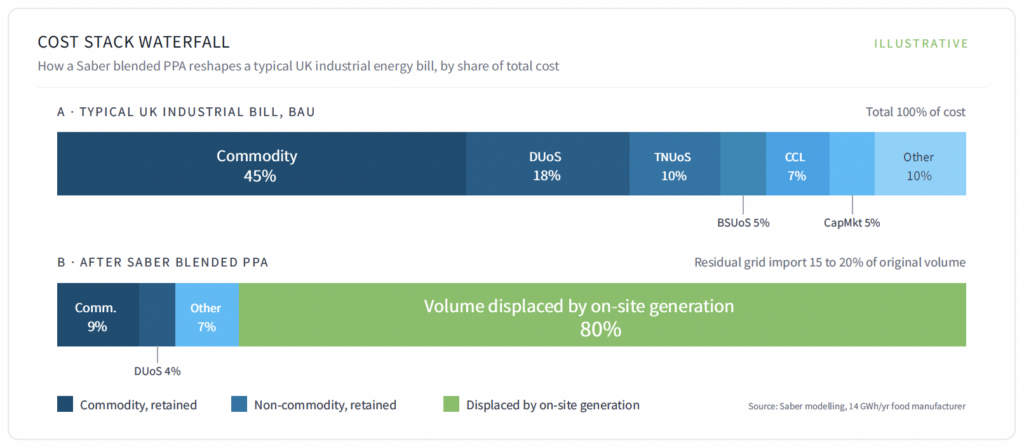
To illustrate what this looks like in practice: Saber’s own modelling on a 14 GWh per year food manufacturer shows that a blended PPA displaces around 80% of total grid-imported electricity volume behind the meter. On a typical industrial bill, that means the commodity element drops from around 45% of total cost to around 9%, and DUoS from 18% to around 4%. The non-commodity charges do not disappear entirely, but they fall in line with the reduction in grid import volume. The two largest cost lines on the bill, addressed simultaneously, under one agreement.
Capital outlay: zero. The assets are funded, designed, operated, and maintained by Saber. The site pays for metered output at a pre-agreed rate. Performance, weather, and market risk sit with Saber.
The compliance answer
Hydrogen-ready CHP addresses the EA question directly. The units Saber deploys, through its exclusive partnership with 2G Energy, are operational on natural gas today and specified to run on blended hydrogen as the gas network decarbonises. The engine pathway is already proven, including units in commercial deployment running on 100% hydrogen.
On Scope 2, displacing grid-imported electricity delivers a measurable, auditable reduction that supports market-based reporting. On Scope 1, hydrogen-ready CHP provides a credible long-term pathway: as biomethane and hydrogen supply develop, the engine is already specified to use them. A defensible answer on process heat decarbonisation, without stranding capital in technology the transition leaves behind.
One question worth sitting with
If your current energy contract is not reducing your non-commodity exposure, not addressing your process heat, and not giving your sustainability team anything auditable, it is not solving your problem. It is deferring it to the next renewal.
The right question is not “what is the best tariff available?” It is “what is the right technology mix for this site, and what does a fifteen-year agreement look like against business as usual?”
That is the question a blended PPA is designed to answer.
Share twelve months of half-hourly data and a basic site pack with Saber. We will return an indicative blend, a savings range, and a delivery timeline within four to six weeks. No capital commitment required.
Get in touch