High Energy Costs and the Deindustrialisation Risk Facing UK Industry
UK industrial energy bills are more than just the unit rate. Distribution charges, transmission costs, and levies sit on top, and none of it is negotiable under a standard supply contract. This article looks at what is driving the pressure and how a zero-capex blended PPA can shift the cost profile for multi-site manufacturers.
UK manufacturers are under sustained pressure from high energy costs, and the impact is now being felt in investment decisions, production planning, and long-term competitiveness. Recent Make UK reporting shows that rising costs remain one of the sector’s biggest concerns, while media coverage of the survey suggests a meaningful share of manufacturers are considering moving production abroad or delaying investment.
For energy managers and finance directors across multi-site operations, this is not a distant policy issue. It is a live commercial challenge affecting margins, resilience, and capital allocation.
What is driving the cost
UK industrial electricity prices remain among the highest in the G7, creating a structural disadvantage for many manufacturers. Recent UK government statistics on industrial energy prices and industry reporting both point to industrial energy prices remaining well above those in many peer economies.
The commodity price is only part of the bill. Distribution charges, transmission costs, balancing costs, the Climate Change Levy, and capacity market charges all contribute to the final cost of electricity. In a standard supply contract, these elements are largely passed through rather than removed.
Gas prices also remain relevant. Because gas still influences the marginal price of electricity in much of the GB market, electricity costs can stay exposed to fuel-market volatility even when procurement is well managed.
Why on-site generation matters
Demand reduction and procurement improvements can help, but they do not remove exposure to grid electricity pricing. On-site generation can reduce that exposure.
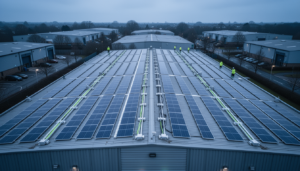
A CHP unit converts fuel into electricity and usable heat, which can improve overall energy efficiency where there is a consistent heat load. Solar generation can reduce imported electricity during daylight hours, while battery storage can shift that output into periods when grid prices are higher. The actual benefit depends on the site’s operating profile, tariff structure, and technical design.
The main advantage is not that on-site generation eliminates all energy costs. It is that it can change the cost profile. Lower grid import can reduce exposure to some usage-based charges, improve price predictability, and support greater operational resilience. The site remains connected to the grid and retains backup supply.
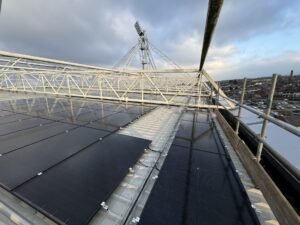
This is the basis of Saber’s blended PPA model. Solar PV, battery storage, and hydrogen-ready CHP are combined under a single zero-capex Power Purchase Agreement, sized to the site’s actual load profile. No capital outlay is required. The site pays for the energy produced at a fixed rate below what it currently pays, and Saber manages performance over the life of the contract.
The regulatory context
Policy support for energy-intensive industry is becoming a bigger part of the debate. The British Industrial Competitiveness Scheme is intended to support industrial users, and industry groups such as Make UK have called for faster and broader relief.
Any site considering CHP or similar plant also needs to account for compliance requirements. Medium combustion plant rules apply to relevant equipment, and operators need to consider emissions limits, permitting, and reporting obligations. The CHP units Saber deploys through its partner network are hydrogen-ready, which may offer future flexibility as alternative fuels become more widely available.
What finance directors should model
A credible investment case needs site-specific numbers, not general market commentary.
The core inputs are capital cost, avoided grid electricity purchases, maintenance, fuel, export income where relevant, and any capacity market or flexibility value. For CHP, the value of displaced heat can also be significant. A 20 to 25 year financial model, using realistic energy-price assumptions and an appropriate discount rate, will show whether the project creates value and where it becomes uneconomic.
Under Saber’s zero-capex blended PPA structure, the capital cost sits with Saber rather than the site. The FD’s model therefore focuses on the difference between the contracted PPA rate and the current grid cost, across the full blended volume, over the contract term. For energy-intensive sites, that difference is often material from year one.
The right question is not whether energy prices are high. It is whether a blended PPA can deliver a better risk-adjusted outcome than continuing to rely fully on the grid. For many energy-intensive sites, the answer may be yes, but it should always be tested against site-specific data.
Why portfolio planning helps
Not every site will be suitable for a standalone PPA. Roof area, grid capacity, heat demand, operating hours, and planning constraints all affect feasibility. A structured portfolio review is the best way to identify which sites can deliver the strongest return.
Starting with the strongest candidates can create early savings that support later phases, and gives decision-makers a clearer basis for approval because the case is built on measured site data rather than assumptions.
One of the key advantages of Saber’s multi-site approach is the ability to merge all sites within a portfolio into a single PPA at one price across the entire estate. Some sites may be too small to access a standalone PPA independently. By bringing them into the wider portfolio agreement alongside larger sites, no site is disadvantaged. Every site in the group benefits from the same contracted energy rate, regardless of its individual scale.
The case for acting now
Manufacturers continue to face difficult choices about investment, production location, and workforce planning. The businesses best placed to remain competitive in the years ahead are likely to be those that reduce exposure to volatile grid prices before conditions change again.
Every year spent waiting is another year of full grid-price exposure that a blended PPA could potentially reduce, with no capital required to get started.
If your estate includes energy-intensive sites, the most useful first step is to share twelve months of half-hourly import data alongside a basic site pack. Saber can return an indicative blend, a savings range, and a delivery timeline within one to two weeks, at no cost and with no commitment at that stage.
Download our manufacturing white paper
For a deeper look at how a blended PPA can reduce grid exposure, improve energy resilience, and support multi-site investment planning across UK manufacturing operations, download the Saber manufacturing white paper.