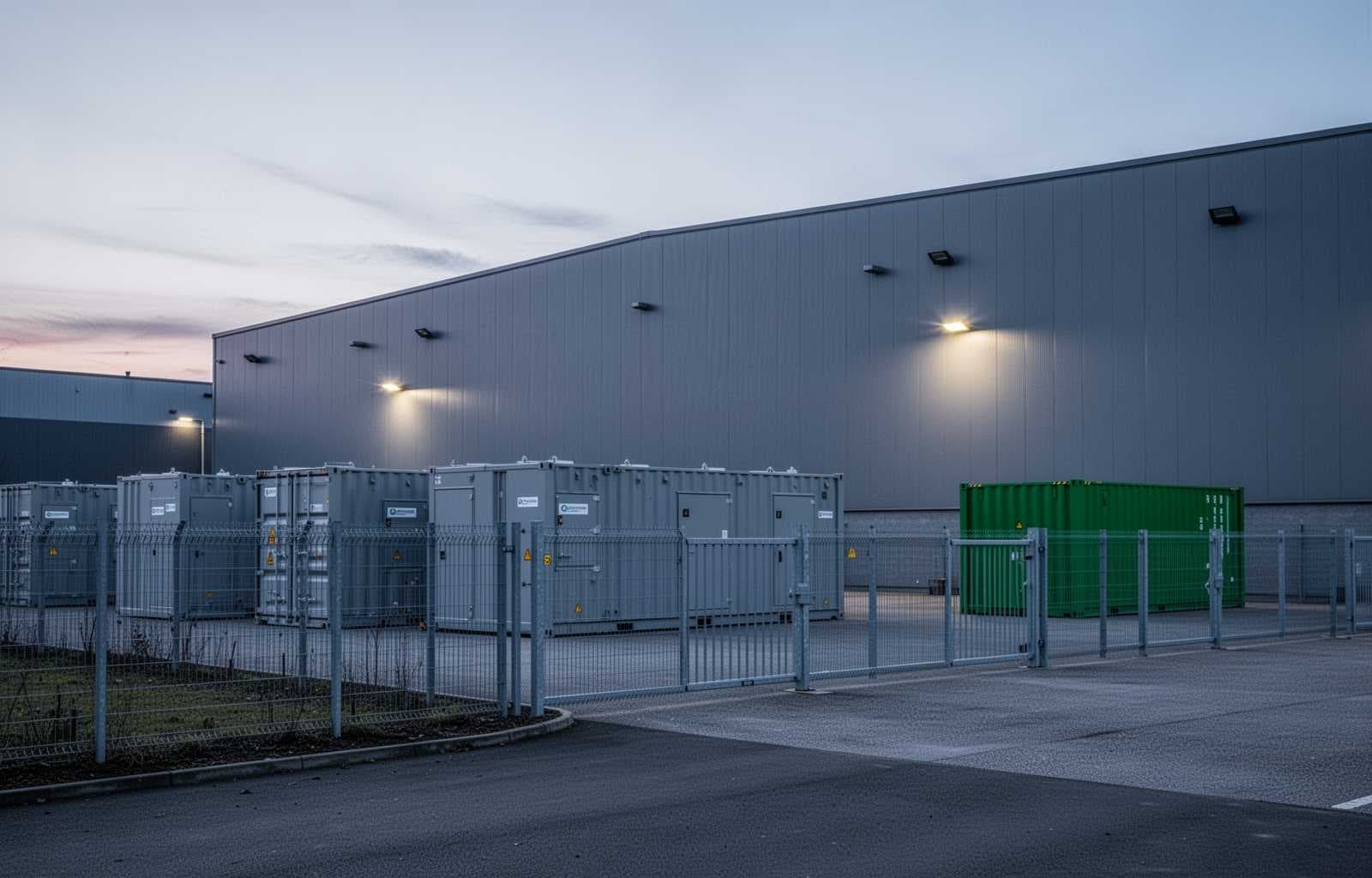

BESS
Battery storage (BESS)
Funded, built and operated by Saber. No capex.
Battery energy storage, or BESS, stores cheap or self-generated electricity and discharges it when the site would otherwise buy dear power or push through a demand peak.
BESS
What does on-site battery storage actually earn?
Battery energy storage, or BESS, stores cheap or self-generated electricity and discharges it when the site would otherwise buy dear power or push through a demand peak. A battery does not make money by producing electricity. It makes money by moving it in time. On a UK business tariff that is roughly 45 per cent commodity and 55 per cent non-commodity, so the value comes from three places: charging from solar or from cheap off-peak grid imports and discharging into the expensive afternoon peak, cutting the maximum import capacity that drives capacity and network charges, and supporting the site when generation and load do not line up. BESS on a Saber PPA makes that work with no capital outlay. Saber funds the cabinets, the inverter and the connection, and operates the dispatch strategy against the site’s own half-hourly data.
3 value stacks
Arbitrage, demand charge, self-consumption
Indicative. Stacked, not chosen one at a time
~55%
Of a typical industrial bill is non-commodity
Indicative. The half a battery is aimed at
Zero
Capital outlay
Saber funds cabinets, inverters and connection
Where this fits
One technology is rarely the answer on its own.
Saber sizes the blend to the site’s demand profile rather than to whichever technology is easiest to sell. These are the combinations this technology usually earns its place in.
Commercial questions
What buyers ask about BESS.
Direct answers, with the assumptions stated rather than buried.

Send us your half-hourly data and we will model it.
Twelve months of import data and a site pack is enough for an indicative blend, output range and unit rate, usually returned within one to two weeks and subject to feasibility.